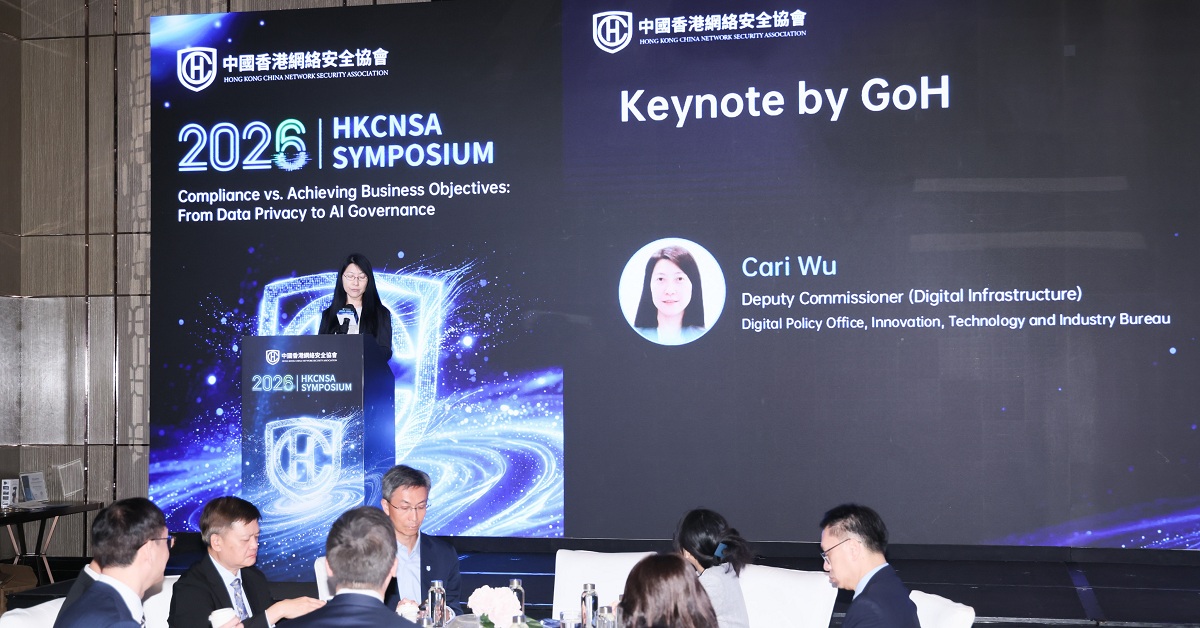
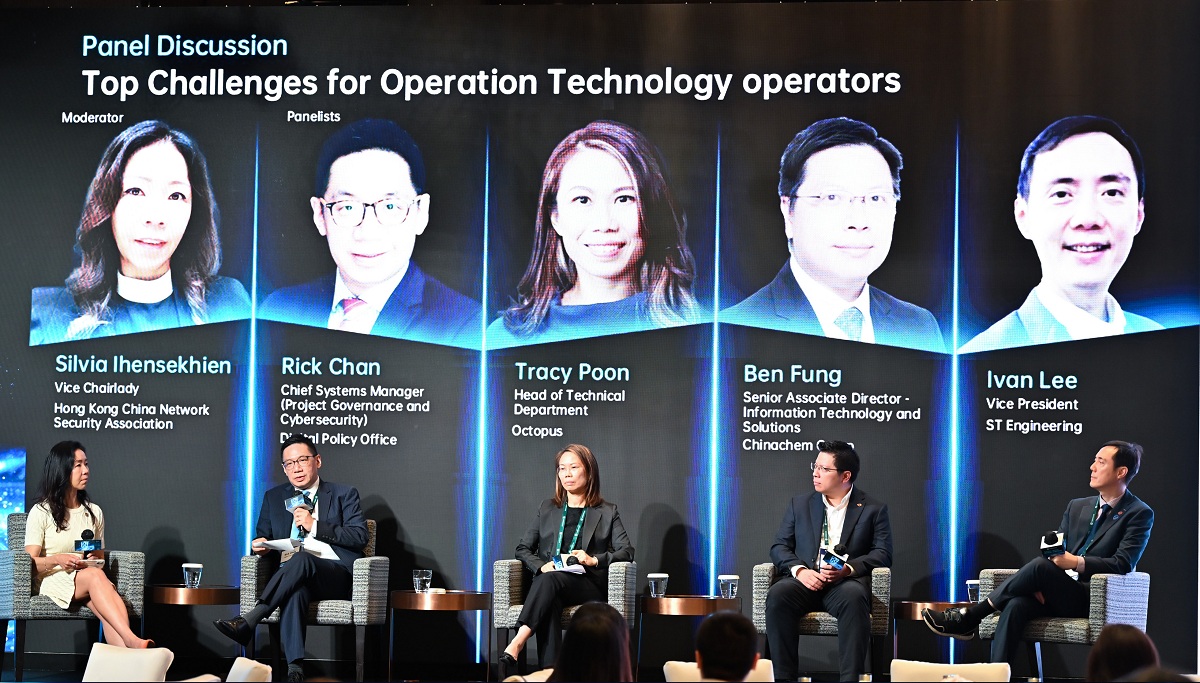
Keynote Speech by the Acting Deputy Commissioner (Digital Infrastructure), Ms Cari Wu, at the “Hong Kong China Network Security Association Symposium 2026” (with photos)
David (Founding Chairman of the Hong Kong China Network Security Association), Ada (Privacy Commissioner for Personal Data Office), Francis (Commissioner of Critical Infrastructure (Computer-system Security) of Security Bureau), Raymond (Chief Superintendent of Cyber Security and Technology Crime Bureau, Hong Kong Police Force), distinguished guests, ladies and gentlemen,
Good morning. It is my honour to join you today at the Hong Kong China Network Security Association Symposium 2026.
Today’s theme, “Compliance vs Achieving Business Objectives: From Data Privacy to AI Governance”, is perfectly timed for this era of rapid, AI-driven digital transformation. Noticing the word “versus”, which often implies a battle between two opposing forces, perfectly captures a misconception in the minds of many. For years, a narrative has persisted that compliance and security are locked in a zero-sum game with technological advancement, suggesting that to maintain cybersecurity, we must somehow sacrifice or compromise innovation. Here, I thank the Association for bringing us together to dispel this myth, and to demonstrate how the two are not opponents, but crucial partners of the same success story in responsible technological development.
At the heart of this discussion is the rapid development of AI. Recognising both its potential and risks, and in full alignment with the National AI+ Initiative, the Government is committed to accelerating the development of AI, while cultivating a secure ecosystem for its sustainable growth.
Following the proposal in the 2026-27 Budget, the Government has established the Committee on AI+ and Industry Development Strategy to formulate strategies that create optimal conditions for AI to empower and transform various industries.
To ensure that AI’s immense potential does not remain confined to research laboratories, translating research and development (R&D) outcomes into real-world use cases is critical. To accelerate this transition, the Hong Kong Artificial Intelligence Research and Development Institute will commence operation in the second half of this year, bridging upstream R&D with midstream and downstream transformation. By developing AI standards with reference to national and international standards, and offering safety assessment and consulting services to local AI developers and enterprises, it will empower local players to train and test models securely. Ultimately, this will minimise compliance risks and strengthen public trust in AI.
Robust infrastructure is the backbone of any thriving AI ecosystem, and Hong Kong is rapidly expanding its own. Currently, Hong Kong possesses an overall computing capacity of 5 000 peta-floating point operations per second (PFLOPS), of which 3 000 PFLOPS are provided by the AI Supercomputing Centre at Cyberport. To accelerate adoption, the Government has allocated $3 billion for the AI Subsidy Scheme, supporting universities, R&D centres and enterprises in leveraging these resources. Hong Kong’s overall computing capacity is expected to grow 36 times to around 180 000 PFLOPS by 2032, driven by the upcoming Sandy Ridge Data Facility Cluster in the Northern Metropolis. This exponential growth will lower the barrier for local firms and research institutions to undertake large‑scale AI projects, attract global talents and position Hong Kong as a global AI innovation hub.
Yet, as we celebrate the opportunities AI brings, we must remain highly vigilant against the emerging cyberthreats it enables. AI can supercharge productivity but it also equips criminals with advanced tools to commit cybercrimes, such as deep-fake scams, personal data infringement and targeted phishing campaigns. Protecting our cybersecurity landscape is not a peripheral concern but the very foundation for the responsible development and safe application of the technology.
To advance AI governance, the Digital Policy Office (DPO) published the Ethical Artificial Intelligence Framework in 2023 and the Hong Kong Generative Artificial Intelligence Technical and Application Guideline in 2025, providing a governance framework tailored to our local context and offering guidance on key areas of AI development such as system robustness, personal privacy and data security. Complementing these, the DPO has also maintained a comprehensive set of IT security policies and guidelines for government bureaux and departments. These are reviewed regularly to meet the evolving security challenges posed by emerging technologies. Furthermore, these resources are publicly available as we work to empower the public and organisations of all sizes to adopt appropriate risk‑management measures and build resilience against the latest cyber threats.
In response to the growing adoption of AI, the DPO will focus on launching several key AI-related cybersecurity initiatives in the second half of 2026, ensuring that the general public and organisations possess adequate security awareness and literacy needed to utilise AI safely. For instance, we are co-ordinating with the Hong Kong Internet Registration Corporation Limited to introduce the Secure AI@Work Enablement Campaign to assist enterprises in building a secure and compliant AI ecosystem. Furthermore, we are also collaborating with the industry to host the AI x Cybersecurity Challenge to leverage the potential of driving AI-powered threat detection and resilience while advancing cybersecurity talent development.
Complementing these efforts, we regularly conduct joint‑departmental and attack‑and‑defence drills. These exercises test the resilience of our own systems and sharpen our incident response capabilities, ensuring that we are well-prepared for the evolving threats in this new technological era.
Looking ahead, as emerging technologies continue to advance, we must also evolve and stay prepared. By laying a solid foundation today through strategies formulating, infrastructure expansion and rigorous cybersecurity governance, we strive to position Hong Kong to fully harness the benefits of AI while mitigating its risks. The Government remains committed to deepening collaboration with industry, academia and the public to safeguard our digital ecosystem. Together, let us embrace technological advancements for building a secure, thriving digital future that truly benefits everyone in Hong Kong.
Thank you, and I wish you all an insightful and rewarding symposium today.
- ENDS -