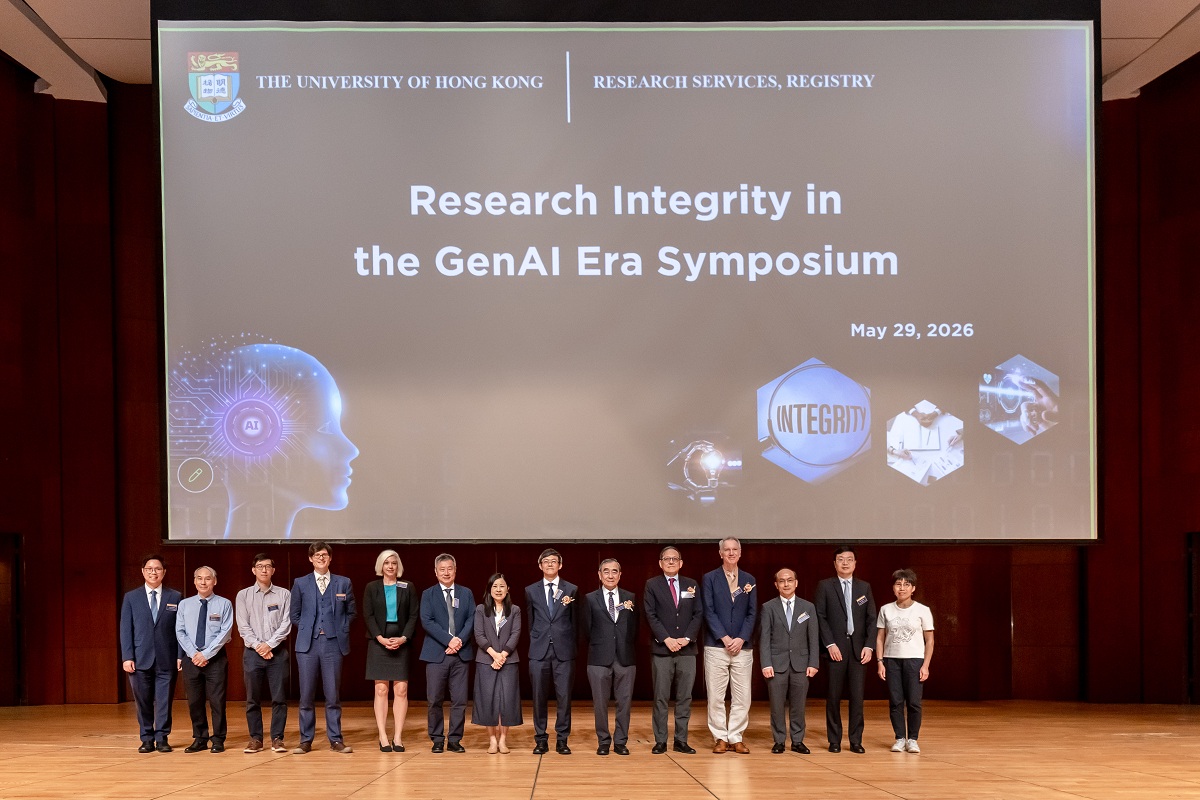
Opening Remarks by the Deputy Commissioner (Data Governance), Dr Ng Ping Chung, at the “Research Integrity in the GenAI Era Symposium” (with photos)
Professor Wong (Provost and Deputy Vice-Chancellor, The University of Hong Kong, Professor Richard Wong), Professor Tang (Secretary-General, University Grants Committee, Professor James Tang), Mr Foster (Executive Director, Croucher Foundation, Mr David Foster), Professor Chan (Director of Education and Development for Research Integrity, The University of Hong Kong, Professor Danny Chan), distinguished guests, ladies and gentlemen,
Good morning. It is a pleasure to join you at HKU for this important symposium. The question before us today is no longer whether generative AI will be used in research. It already is. Researchers are using it to search for information, review literature, organise ideas, analyse data, draft materials and explore new possibilities.
The real question is how we use AI in a way that strengthens research, without weakening the trust, originality and accountability on which research depends.
Generative AI brings real opportunities. It can help researchers work faster, test ideas earlier, connect knowledge across disciplines and communicate complex findings more clearly. Used well, AI can support better questions, better analysis and wider access to knowledge.
This is why today’s programme is so valuable. It covers not only AI as a partner in discovery, but also its use across STEM, social sciences, humanities, scholarly publishing, research data management and the responsible conduct of research.
At the same time, generative AI remains an evolving technology. It can produce convincing content quickly, including summaries, essays and references that may appear credible at first sight. Yet a closer look may reveal factual inaccuracies, hidden bias, or even citations to materials that do not exist. The greater the convenience, the more important it is to slow down at the right moments – to check, to verify, and to take responsibility for the final outcome.
In research, this matters especially. AI can be a powerful research assistant, but it must never become the accountable researcher. Research integrity depends on accuracy, honesty, accountability and sound judgment. If AI-generated content is used without proper verification, it may lead to factual errors, fabricated citations, plagiarism, or undue reliance on outputs that have not been independently validated. Speed is useful only when it is matched with integrity.
From the Government’s perspective, good governance is not a brake on innovation; it is what allows innovation to be trusted, adopted and scaled. The Government formulated the Ethical Artificial Intelligence Framework in 2021 to provide practical guidance for the responsible adoption of AI. DPO has continued to take forward Hong Kong’s AI governance work, including guidance on responsible and effective use of generative AI.
The Hong Kong Generative Artificial Intelligence Technical and Application Guideline also highlights issues highly relevant to research, including hallucination, model bias, data governance and risk-based application. These principles and guidance are not designed to stop innovation. They are designed to help institutions and users adopt AI with confidence and responsibility.
More broadly, Hong Kong is building an AI governance ecosystem which supports innovation while safeguarding privacy, accountability and public trust. This requires contributions not only from Government, but also from universities, research institutions, professional bodies, publishers and individual researchers.
For researchers and institutions, responsible AI use should become a practical habit: disclose AI use where appropriate, verify AI-generated outputs carefully, protect unpublished and sensitive data, and keep human judgment at the centre of the research process. These are not abstract principles. They are everyday disciplines that help ensure AI strengthens, rather than weakens, the credibility of research.
I hope today’s discussions will help turn broad principles into practical research habits. The value of AI in research should not be measured only by how quickly it can produce an answer. It should be measured by whether it helps us ask better questions, test ideas more carefully, and uphold the trust that gives research its value. I wish you all a very fruitful symposium. Thank you.
- ENDS -