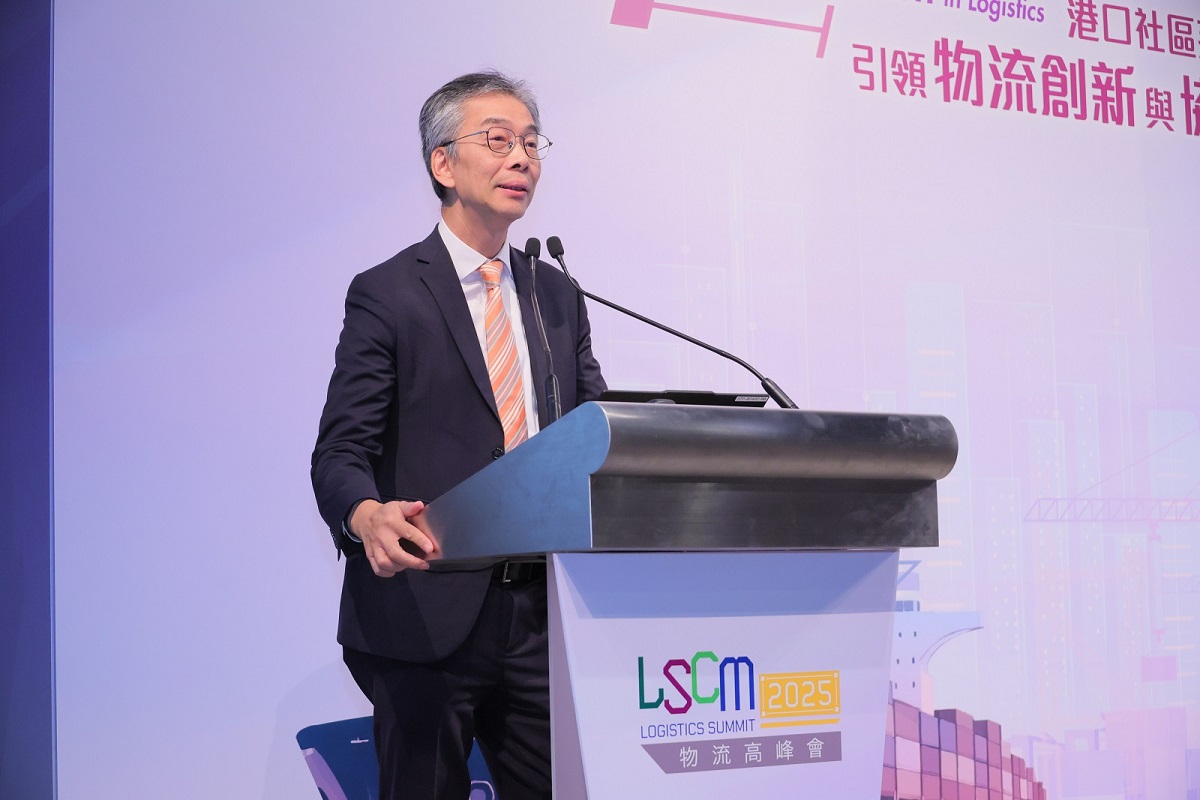
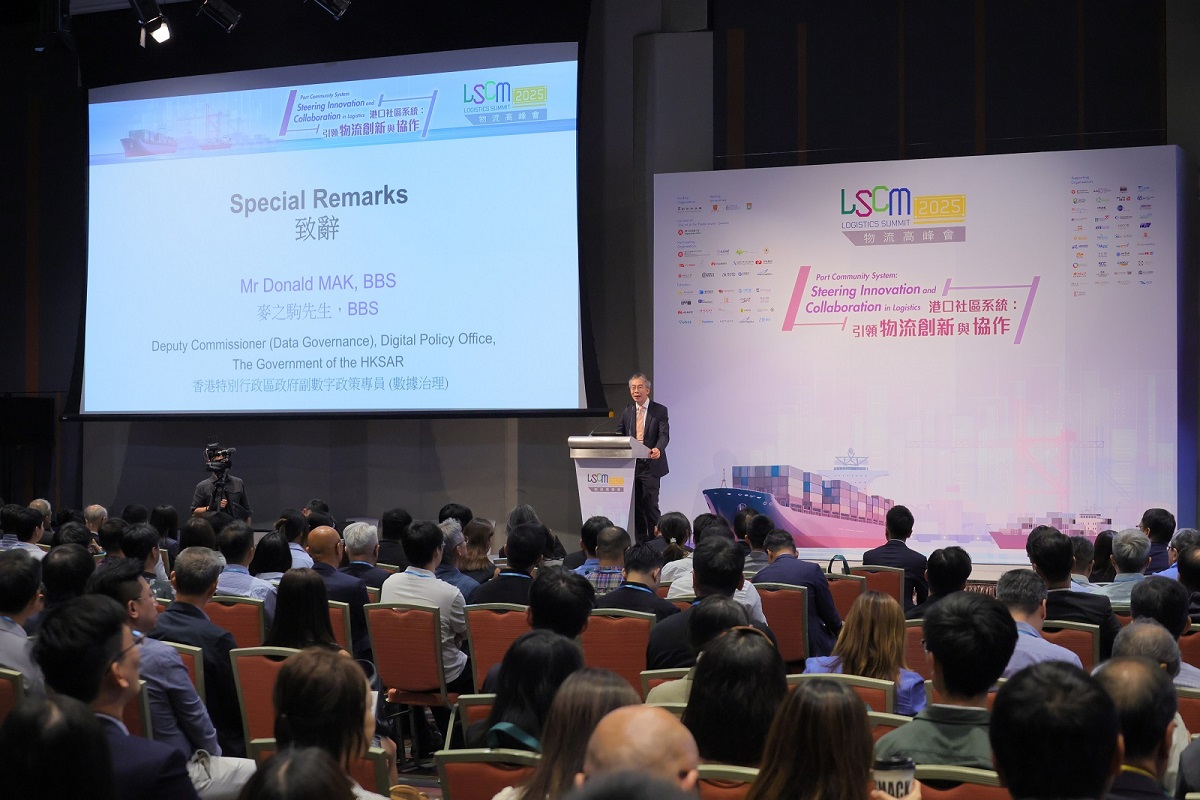
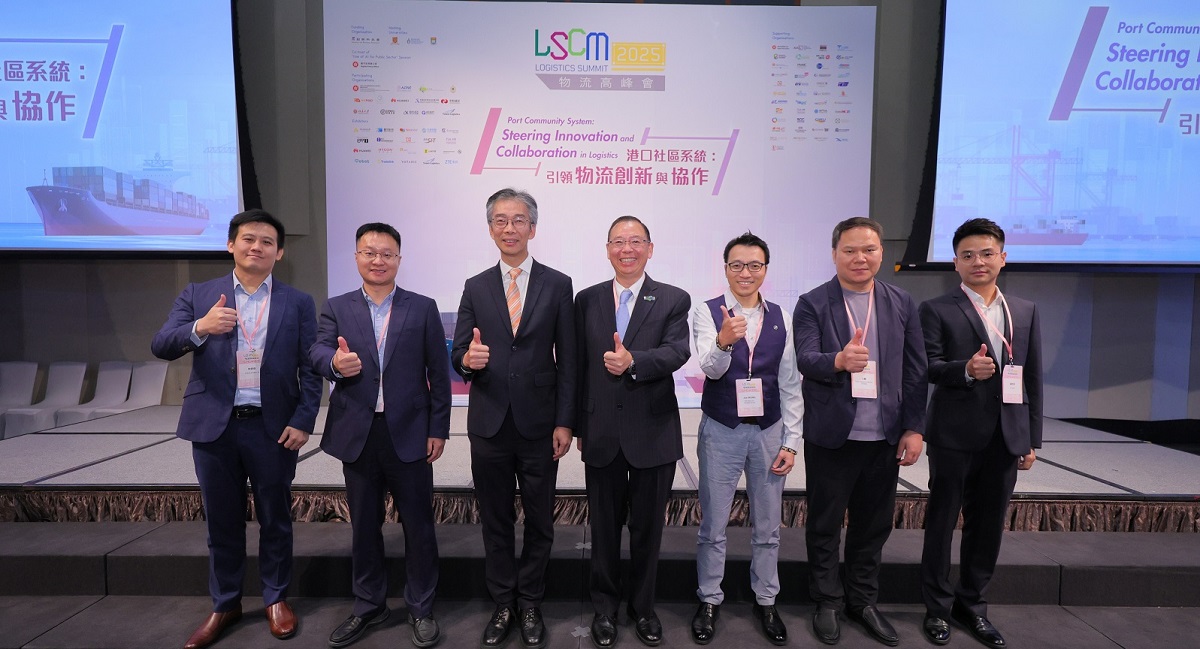
Speech by Mr Donald Mak, BBS, Deputy Commissioner (Data Governance), at the “LSCM Logistics Summit 2025” (with photos)
Simon (Mr Simon Wong, CEO of the LSCM), distinguished speakers and guests, ladies and gentlemen,
Good afternoon. I am delighted to join you all at the afternoon session of the LSCM Logistics Summit 2025. This regular event of LSCM has consistently served as an excellent platform for exchanging ideas and fostering the adoption of new technologies.
As we focus on the theme of the afternoon session, “Use of AI for Public Sector”, I must highlight the fact that the Government has long been promoting the adoption of AI within the civil service. Back in September 2020, we launched the Big Data Analytics Platform, our very own central platform to support government bureaux and departments (B/Ds) to explore and develop AI and big data analytics projects. By riding on the Big Data Analytics Platform, the Digital Policy Office (DPO) and the Transport Department jointly developed the Traffic Data Analytics System (TDAS) in April 2022 to analyse real-time traffic and transport data as well as real-time and forecast weather data collected from the Hong Kong Observatory. The system employs machine learning and has developed an AI model that generates better forecast of traffic conditions such as journey time and traffic speed.
Noting the demand for AI chatbots for customer service and AI computer vision for image and video analytics, the DPO developed the “Chatbot-as-a-Service” infrastructure in June 2023 comprising ready-to-use building blocks such as a natural language processing engine, and the “AI Computer Vision Hub” in March 2024 to support B/Ds to develop more AI applications. These facilities together with the Big Data Analytics Platform enable AI applications for processes including graphics and text recognition during processing of submitted documents or applications, traffic monitoring, water level monitoring, security surveillance, cargo handling zone management and many more.
Apart from the above, various government departments have been proactively exploring and developing applications using AI and robotics technologies in diverse areas of government operations. The most visible examples are AI-powered robots, which perform a wide range of tasks under different conditions, including rescue operations, construction site monitoring, remote sea area surveillance, toxic gas detection, building wall inspections, and underground drainage checks.
Besides outdoor applications, AI has also been utilised for indoor operations across government departments, such as smart customer service, and processing and analysis of data, documents and images. Examples include the application of AI by the Hong Kong Police Force for traffic enforcement; the use of AI by the Census and Statistics Department for trade data analysis; the implementation of AI-driven rostering system by the Government Flying Service to optimise crew scheduling; and the use of AI for enhancing the Government’s 1823 contact centre services to provide feedback to citizen’s enquiries and facilitate the handling of complaints.
To promote and accelerate AI adoption in the Government, our Office has recently launched the “AI+ Civil Services” Campaign, focusing on promoting broader use of AI within the Government. Under the campaign, the DPO has introduced an AI+ Tool and Solution Catalogue, offering a wide range of ready-to-use AI applications to assist B/Ds in identifying suitable AI solutions. Moreover, thematic technology forums, seminars and matching workshops are organised to foster exchange and collaboration between B/Ds and technology providers, and also to enhance government staff’s understanding of AI technologies and applications, and empower government departments to leverage AI for more efficient and intelligent public service delivery.
In the realm of AI research and development (R&D), the Government through the AIR@InnoHK innovation and research platform established the Hong Kong Generative AI Research and Development Center (or HKGAI in short) in 2023, focusing on the R&D of local generative AI foundation models and related applications. In February this year, the HKGAI successfully launched Hong Kong’s first large language model (LLM).
Based on this LLM, the HKGAI has developed a series of generative AI applications, including HKPilot, HKChat and HKMeeting, which are currently being piloted by around 30 000 government staff across all B/Ds, assisting with tasks like document drafting, translation, summarisation, meeting minute-taking, and AI-powered information retrieval.
We are fully aware that effective AI governance is crucial for the safe and responsible adoption of AI. It is imperative to strike a balance between fostering innovative AI applications and addressing the associated risks. To this end, our Office had developed the “Ethical Artificial Intelligence Framework” in 2021 and updated it in July 2023 to provide guidance for government departments in adopting AI technologies through a structured approach that integrates ethical considerations into their IT projects and services. Additionally, in April this year, the DPO promulgated the Hong Kong Generative Artificial Intelligence Technical and Application Guideline to provide appropriate codes and best practices for the development and use of generative AI technologies.
To further accelerate the application of AI within the Government, the Chief Executive had announced in his 2025 Policy Address a series of new initiatives, with a view to further enhancing public service effectiveness and efficiency through the use of AI. Among others, the Government will set up the AI Efficacy Enhancement Team to co-ordinate and steer government departments in applying AI technology to their work effectively, exploring process re-engineering opportunities, and promoting technological reform in departments to improve efficacy. Led by the Deputy Chief Secretary for Administration, the team will examine with government departments their needs for reform, with priority given to departments with greater interface with the public. The AI Efficacy Enhancement Team will also drive government departments to launch “AI flagship projects” to make use of AI in expediting their processing of various licences and applications. In addition, the DPO will develop an “AI Assistant” and integrate it into “iAM Smart” and the “Digital Corporate Identity” platform to provide users with instant responses to enquiries, personalised services, and tailored recommendations for suitable funding schemes and public service support for enterprises (especially small and medium enterprises).
Moreover, the Digital Policy Office will roll out various AI applications in respect of data analytics, customer service and document processing to promote extensive application in departments, while ensuring security and controllability.
Ladies and gentlemen, the emergence and rapid evolution of AI present an opportunity for advancements that we all cannot miss. The Government will continue to champion AI and leverage its transformative potential to deliver better public services. I firmly believe that all organisations will benefit from the use of AI to enhance their efficiency and competitiveness.
I anticipate that the insights shared by prominent I&T leaders and experts at this Summit will inspire a wealth of brilliant and innovative ideas. I eagerly await the exciting collaborative AI projects that will emerge from the LSCM and its partners.
As I conclude, I wish you all a rewarding experience at the LSCM Summit 2025. Thank you.
- ENDS -