Industrialisation of Modular Integrated Construction

The Policy Vision
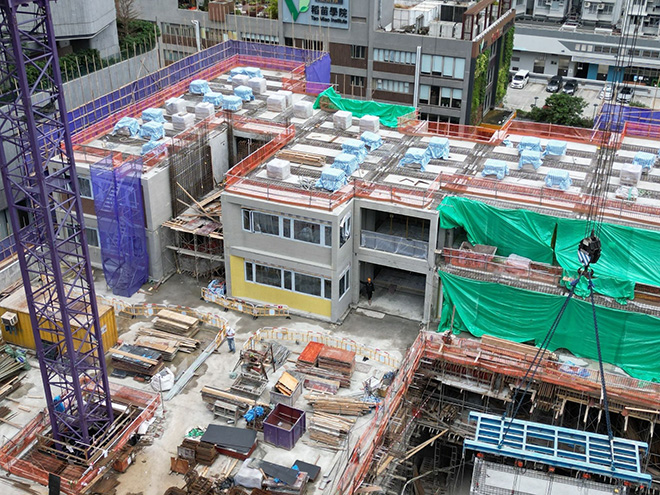
The Development Bureau (DevB) promotes Modular Integrated Construction (MiC) to boost industry’s productivity and support cross‑boundary business, addressing declining productivity due to ageing labour in recent years, relatively high construction costs and site safety issues while accelerating housing and infrastructure delivery. MiC is a construction method where freestanding volumetric modules, completed with finishes, fixtures, fittings and most building services installations, are manufactured off-site and then transported to site for assembly. This method not only contributes to the project quality and sustainable built-environment but also helps ease the challenges of the local construction industry, with a view to enhancing speed, quantity, efficiency and quality. Using Building Information Modelling (BIM) and digital coordination in MiC, modules’ design are completed before factory production, improving quality and cost effectiveness. DevB’s technical circular sets clear standards for the policy of MiC to ensure the effective implementation of MiC.
Cross-boundary Supply Chain
Recognising MiC’s cross‑boundary nature, with the Greater Bay Area (GBA) as a main manufacturing base for MiC modules and Hong Kong as an application and export hub, DevB has digitalised works supervision and quality assurance, streamlined and enabled cross-boundary trade as well as regulatory processes to make cross‑boundary MiC business more conveniently and efficiently. The Guangdong–Hong Kong MiC Cross‑boundary Trading Guidebook (Guidebook) sets out end‑to‑end procedures for customs, tax and bonded processing trade. Under this model, imported MiC modules are exempt from Mainland customs duties and value-added tax. DevB has also organised forums in Hong Kong and Shenzhen to explain the Guidebook and digital workflows, receiving strong industry support.
Accreditation and Market Transparency
To strengthen quality assurance for MiC manufacturing, DevB has introduced relevant institutional and digital tools. The MiC Manufacturer Accreditation Scheme (MiC-MAS), implemented by the Building Technology Research Institute (BTRi), accredits manufacturers meeting required standards. Accreditation will become a prerequisite for government MiC projects with streamlined approvals for accredited manufacturers. The first MiC Annual Demand Forecast jointly published by DevB and CIC in June 2025 projected about 2.5 million square metres of MiC floor area for five years between 2025 and 2030, offering valuable market intelligence for investment and capacity planning.
Digital Construction
From a technological perspective, MiC uses BIM for precise digital prototyping to avoid on-site construction clashes. Some MiC projects with blockchain technique for e-inspection and automation enable remote quality control, efficient position tracking, and also enhance high-quality modular production.
Taken together, DevB’s initiatives show how strategic policy, digitalisation and business facilitation reinforce one another:
- Policy and standards create a clear and stable framework for digital construction methods.
- Digital tools and processes (BIM, digital approvals, digital swept path analysis, etc.) make MiC manufacturing more efficient, safer and with higher‑quality.
- Business facilitation measures, including guidebooks, tax and customs arrangements, accreditation scheme, market forecasts and international promotion, reduce friction and unlock investment across the MiC supply chain.
As a result, over 150 government and private local projects have already adopted MiC. DevB’s approach demonstrates how government acts as an enabler, helping transform MiC from a promising technology into a structured, scalable industry that positions Hong Kong and the GBA as a globally competitive MiC hub.
Click here to learn more about DevB’s measures in enhancing development of the MiC industry.
[Acknowledgement to the Development Bureau for providing material for the story.]
Business facilitation measures under the programme would bring benefits in the following areas



Be the Smart Regulator Programme
Launched in 2007, the “Be the Smart Regulator” Programme aims to improve the efficiency, transparency and business-friendliness of licensing regime, with a view to relieving the compliance costs and administrative burdens of business sectors.
Know More